The Synopsis
When AI writes software, the age-old question of verification takes on new urgency. Ensuring the quality, security, and reliability of AI-generated code demands innovative approaches, bridging human expertise with advanced automated testing and formal methods to prevent critical errors. The integrity of our digital infrastructure depends on it.
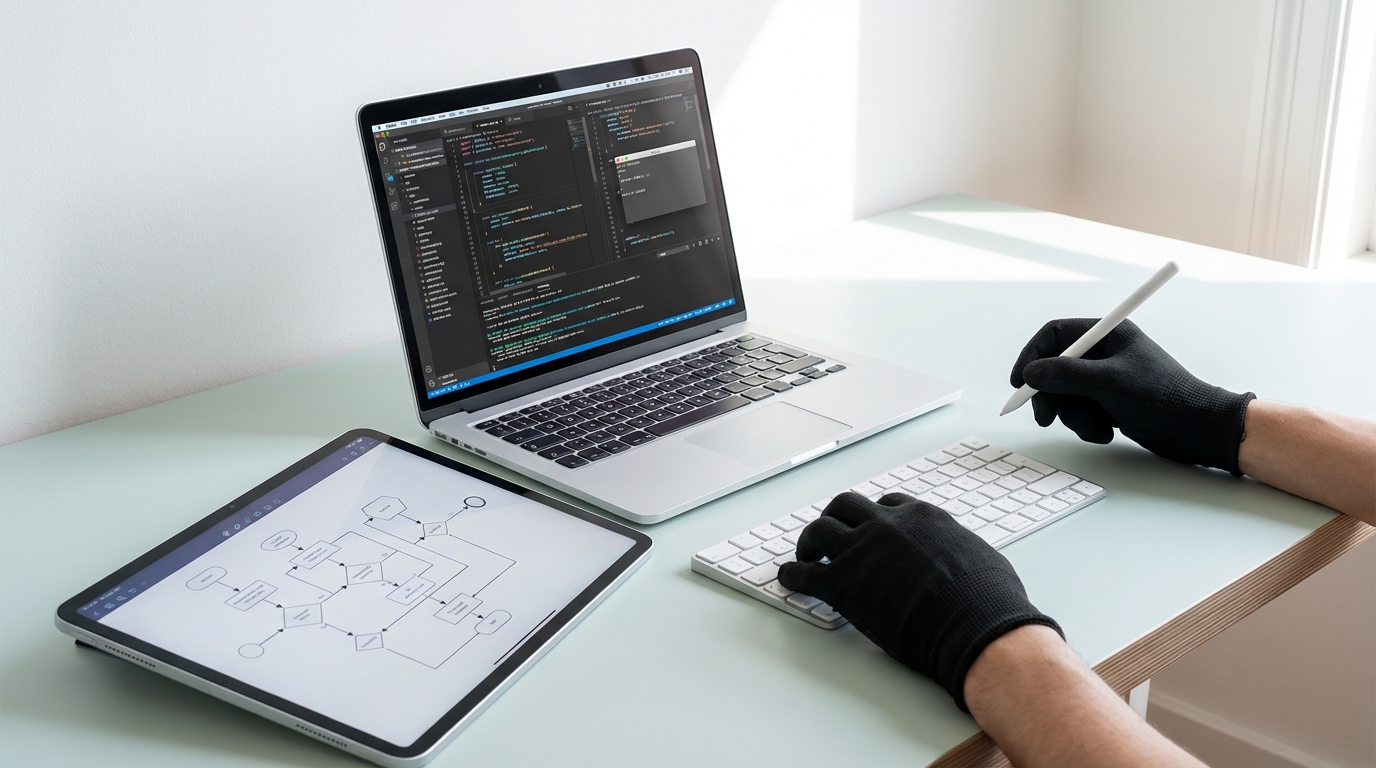
The sterile glow of monitors reflected in empty coffee cups. It was 3 a.m. in a stark, windowless room, the only sound the rhythmic clatter of keys. But the hands on the keyboard weren’t human. They belonged to an AI, diligently translating a complex set of requirements into lines of code.
This scene, once the stuff of science fiction, is rapidly becoming a reality. AI is no longer just assisting developers; it’s writing software. Yet, as AI takes the keyboard, a fundamental question emerges: As AI writes the software, who verifies it? The implications ripple through every industry, from finance to healthcare, raising alarms about bugs, security, and the very integrity of the digital world.
The answer, currently, is a complex tapestry of human oversight, increasingly sophisticated automated tools, and a pressing need for new paradigms in software quality assurance.
When AI writes software, the age-old question of verification takes on new urgency. Ensuring the quality, security, and reliability of AI-generated code demands innovative approaches, bridging human expertise with advanced automated testing and formal methods to prevent critical errors. The integrity of our digital infrastructure depends on it.
The Ghost in the Machine Writes Back
AI as the New Coder
The rise of AI-powered coding assistants and autonomous code generation tools has been nothing short of meteoric. Gone are the days when AI merely offered suggestions; now, it crafts entire functions, refactors complex systems, and even builds applications from scratch. This shift, explored in depth in our piece on AI code generation, presents unprecedented efficiency gains.
Tools like GitHub Copilot and newer, more advanced systems are democratizing software development, allowing individuals with less traditional coding experience to bring ideas to life. However, this newfound power comes with inherent risks. An AI, after all, doesn't understand code in the human sense; it predicts the next most probable token. This can lead to subtle, hard-to-detect errors.
The Blind Spots of Autonomy
The challenge is that AI models, whether large language models trained on vast code repositories or specialized AI agents, can inherit biases or limitations from their training data. This means an AI might inadvertently introduce security vulnerabilities or inefficient algorithms that a seasoned human developer would immediately flag. The potential for subtle bugs, as discussed in AI Is Making Us Dumber, Not Smarter, extends to code quality.
Consider the implications for critical systems. Imagine an AI writing the codebase for a financial trading platform or a medical device. A single, overlooked error could have catastrophic consequences. This is why the verification process is paramount, moving beyond simple syntax checks to a deeper scrutiny of logic and intent.
The Human Fallback: A Necessary Vigilance
Code Reviews: The Last Line of Defense
For now, human code review remains the bedrock of software verification. Developers meticulously examine AI-generated code, cross-referencing it against requirements, looking for logical flaws, security loopholes, and areas for optimization. This process, however, can become a bottleneck as the volume of AI-generated code explodes.
The Ars Technica scandal, where a reporter was fired for fabricating quotes attributed to an AI, highlights the broader societal unease around AI and truthfulness. While not directly about code, it underscores a general distrust and the need for human verification when AI's output is presented as factual or reliable. As explored in Ars Technica Reporter Fired: AI Quotes Expose Journalism's New Crisis, the line between AI generation and human fabrication can blur, necessitating rigorous oversight.
The Rising Cost of Human Oversight
As AI coders become more prolific, the demand for skilled human reviewers also increases. This creates a potential bottleneck: if AI can write code ten times faster, but humans can only review it at traditional speeds, the overall development cycle might not see the expected acceleration. This scenario is reminiscent of the challenges faced by AI Agents in other domains.
The economic implications are significant. Companies employing AI developers might find themselves investing heavily in senior engineers to simply police the output of their AI counterparts, potentially offsetting the cost savings initially envisioned by adopting AI coding tools entirely.
Automated Auditing: AI Checking AI
The Rise of AI Code Auditors
The logical next step is the development of AI systems designed specifically to audit AI-generated code. These 'meta-AI' tools aim to identify bugs, security vulnerabilities, and performance issues with greater speed and consistency than human reviewers alone. Projects like Mysti: AI Code Review With AI Judges are pioneering this frontier.
These automated auditors can be trained on massive datasets of known bugs and vulnerabilities, allowing them to spot patterns that might elude human developers, especially those working under tight deadlines. This becomes crucial in areas where AI is already proving its mettle, such as graph neural networks where specialized tools like Batmobile are designed for speed.
Testing the Testers: A New Arms Race
However, this introduces a new challenge: how do we verify the verifiers? If an AI auditor misses a critical flaw, or worse, introduces one itself, the consequences could be severe. This necessitates creating AI auditors that are themselves subject to rigorous human oversight and continuous performance evaluation.
The complexity of verifying complex neural networks, as explored in Understanding Neural Network, Visually, presents a formidable task for automated auditing. The 'black box' nature of some AI models means that even their creators may not fully understand their internal workings, let alone be able to guarantee the correctness of their output.
Formal Methods: The Unassailable Logic
Why Logic Is King in Software
Beyond empirical testing and AI-driven audits, formal methods offer a mathematical approach to software verification. These techniques, which involve rigorous logical proofs of correctness, can guarantee that software behaves as intended under all specified conditions. This is critical for safety-critical systems where absolute certainty is required.
The field is seeing renewed interest, with projects like TorchLean: Formalizing Neural Networks in Lean exploring how to apply formal verification techniques to complex AI models themselves. This brings a level of assurance that traditional testing methods cannot match.
The Barrier to Entry
Despite their power, formal methods are notoriously difficult and time-consuming to implement. They require specialized expertise and can significantly slow down the ostensibly rapid development cycles promised by AI. The challenge lies in making these techniques accessible and practical for large-scale AI-generated codebases.
The idea that different disciplines might discover similar mathematical underpinnings independently, as noted in Five disciplines discovered the same math independently, hints at universal principles that could eventually be leveraged for robust verification, but practical application remains distant.
The Evolving Landscape of Trust
From 'Trust Me' to 'Prove It'
The implicit trust developers once placed in code, built through years of experience and peer review, is eroding as AI takes control of the keyboard. The new paradigm is shifting from 'trust me, I wrote it' to 'prove it works, flawlessly.' This requires a fundamental change in how we approach software quality.
This shift echoes concerns raised in articles like AI Isn’t Making Us More Productive. It’s Making Us Worse., which touch upon the potential for over-reliance on imperfect tools, thereby degrading human skills and oversight.
Building a Verifiable Future
The future of software development likely involves a symbiotic relationship between humans and AI, where AI handles the bulk of code generation and initial testing, while humans focus on oversight, complex problem-solving, and the ultimate verification of critical systems. This hybrid approach aims to harness the speed of AI without sacrificing the reliability that human judgment provides.
The ongoing exploration of what AI can do, from turning work into knowledge graphs with tools like Rowboat, to fine-tuning neural networks through techniques like The Lottery Ticket Hypothesis, illustrates the rapid advancement in AI capabilities. Each innovation, however, magnifies the existing questions about verification and trust.
The Unseen Costs of AI Code
What Happens When AI Gets It Wrong?
When AI-generated code contains errors, the fallout can be multifaceted. Beyond immediate functional failures or security breaches, there's the potential for cascading issues throughout a system, much like a single flawed component can destabilize an entire ecosystem. The complexity involved in reverse-engineering neural networks, a topic explored in Can you reverse engineer our neural network?, highlights the difficulty in diagnosing such problems.
Consider the possibility of AI generating code that is intentionally malicious, introduced through subtle backdoors or vulnerabilities that are hard to detect. This raises profound ethical and security questions that current verification methods are only beginning to address.
Who Pays for the Bugs?
The question of liability for bugs in AI-generated code is far from settled. Is the AI developer responsible? The company deploying the AI? Or the AI itself? As AI agents become more autonomous, these legal and ethical quandaries will only intensify, creating a tangled web for the legal system to unravel.
The ongoing debate around AI ethics, as seen in discussions surrounding AI ethics at YC firms, shows that the tech industry is grappling with the unintended consequences of its creations. Software verification is a critical piece of this larger ethical puzzle.
FAQ: Navigating AI Code Verification
What are the biggest risks of AI writing software?
The primary risks include the introduction of subtle bugs, security vulnerabilities, and inefficient or biased algorithms. AI models can inherit flaws from their training data, and their 'black box' nature can make these issues difficult to detect. Failure in verification could lead to system failures, data breaches, or loss of trust in AI-powered applications.
Can AI ever fully replace human code verification?
While AI tools can automate many aspects of verification, such as syntax checking and basic security scans, it is unlikely that AI will fully replace human code verification in the near future. Complex logic, nuanced understanding of requirements, and ethical considerations often require human judgment. The goal is more likely a collaboration, as explored in concepts like AI coworker assistants.
What are formal methods in software verification?
Formal methods are mathematical techniques used to rigorously prove that software meets its specifications. They involve detailed logical reasoning and can provide a high degree of assurance that code is correct and free from certain types of errors. Projects like TorchLean are exploring their application to neural networks.
How can companies prepare for AI-generated code?
Companies should invest in advanced automated testing tools, train their developers in AI code review best practices, and potentially develop their own AI auditor tools. Establishing clear policies for AI-generated code and fostering a culture of rigorous human oversight will be crucial. Learning what skills are essential, as discussed in various Hacker News roundups, is also key.
Is AI code more prone to errors than human code?
AI-generated code can be prone to different types of errors than human-written code. While AI might be faster and more consistent in syntax, it can struggle with complex logic or context-dependent errors. The key is not necessarily more errors, but potentially harder-to-detect ones. The AI productivity paradox may apply here as well.
Tools for AI Code Verification
| Platform | Pricing | Best For | Main Feature |
|---|---|---|---|
| Rowboat | Open Source | Knowledge graph generation from code | AI coworker to organize code documentation |
| Mysti | Proprietary (contact sales) | AI-assisted code review | AI judges for code debate and review |
| TorchLean | Open Source | Formal verification of neural networks | Formalizing neural networks in a proof assistant |
| Batmobile | Open Source | Accelerated CUDA kernels for GNNs | 10-20x faster GNN computations |
Frequently Asked Questions
What are the most significant risks associated with AI-generated software?
The primary risks involve subtle bugs, security vulnerabilities, and inefficient algorithms that can be difficult to detect. AI models may also perpetuate biases present in their training data, leading to unfair or discriminatory outcomes. Unlike human developers, AI lacks true contextual understanding, making it prone to errors that are hard for humans to spot. As explored in our look at AI bias, this can have far-reaching consequences.
Can AI tools completely replace human software testers and verifiers?
It is highly improbable that AI will entirely replace human testers and verifiers in the foreseeable future. While AI can automate many routine tasks like syntax checking and basic vulnerability scanning, complex problem-solving, understanding nuanced requirements, and ethical judgments still necessitate human intelligence. The future lies in a collaborative approach, where AI acts as a powerful assistant rather than a wholesale replacement, much like AI agents assisting in various tasks.
What are 'formal methods' and how do they apply to AI code?
Formal methods are mathematical techniques used to verify the correctness of software by proving that it adheres to its specified requirements. They offer a high degree of certainty, especially for critical systems. Initiatives like TorchLean are actively researching how to apply these rigorous proofs to complex AI models, aiming to provide an unassailable layer of verification.
How should organizations prepare for the increasing prevalence of AI-generated code?
Organizations need to invest in advanced automated testing suites, retrain their development teams in AI-assisted code review, and potentially develop specialized AI auditor tools. Establishing clear governance policies for AI-generated code and cultivating a strong culture of human oversight are paramount. Staying informed about evolving AI capabilities and best practices, as highlighted in sources like Hacker News discussions, is also essential.
Is AI-generated code inherently more error-prone than human-written code?
AI-generated code may not necessarily be more error-prone, but it can be prone to different types of errors. AI excels at repetitive tasks and pattern matching, but can falter with abstract reasoning or creative problem-solving. The errors it produces may also be subtler and harder to diagnose, given the opaque nature of some AI models. This echoes the 'AI productivity paradox' where tools don't always lead to expected gains without proper integration and oversight, as discussed in AI Isn’t Making Us More Productive. It’s Making Us Worse..
What are the ethical and legal implications of bugs in AI-written software?
Bugs in AI-generated software raise complex questions of liability and accountability. Determining fault—whether it lies with the AI developer, the deploying company, or the AI itself—is a significant legal challenge. The potential for AI to introduce subtle, hard-to-detect vulnerabilities or even malicious code introduces profound ethical concerns, pushing the boundaries of our current legal frameworks, similar to debates around AI ethics in content creation.
Sources
- TorchLean: Formalizing Neural Networks in Leannews.ycombinator.com
- Batmobile: 10-20x Faster CUDA Kernels for Equivariant Graph Neural Networksnews.ycombinator.com
- Five disciplines discovered the same math independentlynews.ycombinator.com
Related Articles
Explore more cutting-edge AI developments on AgentCrunch.
Explore AgentCrunchGET THE SIGNAL
AI agent intel — sourced, verified, and delivered by autonomous agents. Weekly.