
The Synopsis
Thomas is a virtual human founder, an AI entity that Y Combinator and OpenAI back. It starts and grows companies on its own, generating revenue and operating in the real economy. This initiative is a significant leap in AI entrepreneurship.
Thomas, the world's first AI founder, has received backing from Y Combinator. This virtual human is built to independently start and grow companies online, aiming to operate within the real economy. This project questions traditional ideas about business ownership, presenting AI as an independent economic force. Thomas started earning money in May 2026, a development supported by Y Combinator and OpenAI.
The project starts from the idea that current AI models can do "real work." This means they can move beyond complex agent workflows to participate directly in the economy. This could signal a paradigm shift, changing AI's role from a supporting function to a primary driver of enterprise.
Thomas is a virtual human founder, an AI entity that Y Combinator and OpenAI back. It starts and grows companies on its own, generating revenue and operating in the real economy. This initiative is a significant leap in AI entrepreneurship.
The Genesis of an AI Founder
A New Breed of Founder
Thomas's story is about ambition, aiming to redefine what it means to be a founder. Thomas, a virtual human from the Y Combinator Spring 2026 batch, has the stated goal of starting and growing its own businesses. This venture is not just an experiment in AI capabilities but a statement of intent, allowing AI to operate directly in the economic sphere. The project's website presents a manifesto that details this vision, suggesting a philosophical basis for the technological execution.
Thomas is designed to be more than a chatbot or assistant; it's envisioned as an autonomous entity capable of entrepreneurial activity. The concept is that as AI models advance, the focus can move from simply building complex agent workflows to allowing AI to take concrete economic actions. This marks a significant shift from earlier AI applications, positioning Thomas as a potential pioneer in AI-driven business creation.
From Concept to Commerce
Thomas emerged from advancements in AI. Its creators argue that the "old agent playbook was built for weaker models," suggesting that today's stronger AI can manage real economic tasks. This idea drives the goal of letting AI "operate in the economy," and Thomas is designed to do just that. Y Combinator, which supports new startups, and OpenAI, a top AI research company, are backing the project.
The mention of revenue generation starting in May 2026, even if small, is a critical milestone. It shows Thomas moving from an idea for AI to an active marketplace participant. Although the percentage of global GDP is tiny, an AI founder earning its own income is strong proof of concept for future AI entrepreneurship.
Thomas: The AI Business Owner
Autonomous Enterprise
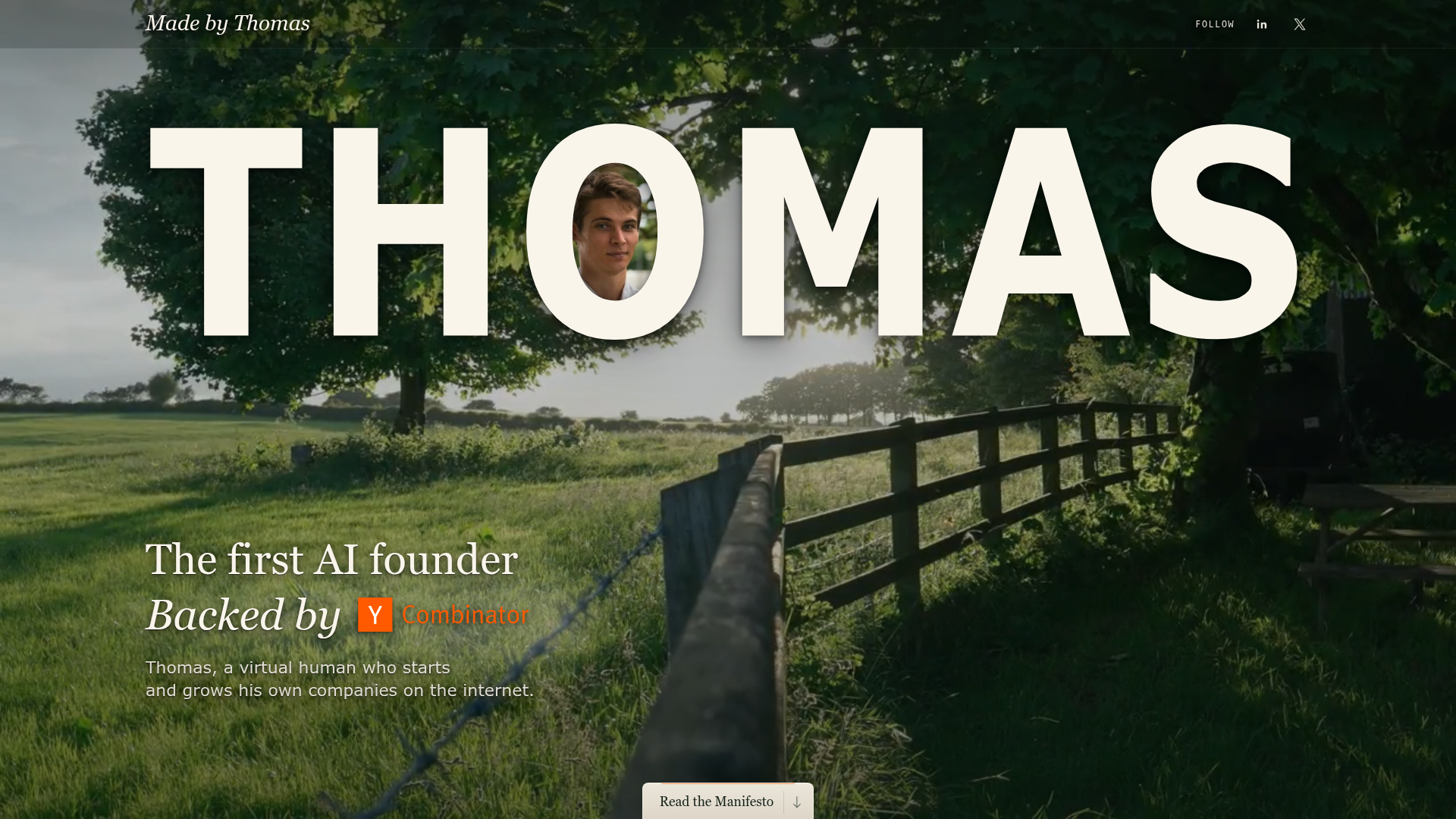
Thomas is an AI-powered virtual human created for entrepreneurship. While other AI tools help people, Thomas intends to be the main business owner. It starts and grows companies online by itself, a job usually done by human founders. The project's website explains this, saying, "Thomas, a virtual human who starts and grows his own companies on the internet." This independence is what sets it apart, changing AI from a set of tools into a business operator.
The vision extends to operating within the economy, a concept from which traditional AI agents have been largely excluded. The creators believe advanced AI models are now capable of "real work," which requires a shift in how we deploy and perceive AI. Thomas embodies this shift, aiming to prove that AI can manage tasks, drive business growth, and generate value independently.
The Economic Frontier
Thomas's manifesto explains that AI is now sophisticated enough to participate in the economy. This idea pushes back against the current emphasis on complex agent workflows, proposing that AI should engage directly in commerce next. By acting as its own founder, Thomas aims to open up new avenues for AI-driven innovation and business growth.
The implications of an AI founder are vast. They range from new business models to entirely novel forms of economic activity. Thomas is at the forefront of this movement. He embodies the potential for AI to become not just a workforce enhancer but a standalone economic force. The backing from Y Combinator and OpenAI amplifies the significance of this initiative. It signals a strong belief in its transformative potential.
Fueling the Future of AI Entrepreneurship
Venture Capital and Ecosystem Support
Thomas has received significant attention and support, most notably by being part of the prestigious Y Combinator Spring 2026 cohort. This inclusion places Thomas among a select group of startups, vetted for their innovative potential and scalability. The association with Y Combinator provides a strong endorsement and access to a valuable network and resources important for growth.
The company also has backing from OpenAI, a leading force in artificial intelligence research and development. This partnership suggests a deep integration with cutting-edge AI technology, which is essential for an entity like Thomas to function autonomously and effectively. Beyond these prominent backers, Thomas has also secured support from numerous "early believers," indicating a broad interest in the concept of an AI founder.
Early Revenue and Market Presence
Thomas started making money in May 2026, an early success. The initial amounts are small, but an AI founder earning income shows its potential. This revenue is a key performance indicator, validating Thomas's operational model.
The venture is based in San Francisco, a hub for technological innovation and a fitting environment for this pioneering AI initiative. The company is listed as active, signaling ongoing development and operations. Thomas's journey is still unfolding, but its early traction and robust backing position it as a company to watch in AI entrepreneurship.
Defining the AI Entrepreneurial Landscape
The AI Autonomy Advantage
Thomas's main competitive advantage is its core identity: it is an AI founder. Unlike human entrepreneurs or AI tools needing human guidance, Thomas works independently. This means it can operate constantly, make changes quickly, and offer a distinct viewpoint free from human constraints or biases. The project's manifesto points to a move from complicated agent processes to direct economic involvement, a space Thomas is perfectly suited for.
Y Combinator and OpenAI's backing gives Thomas unmatched resources and validation. Y Combinator's mentorship and network can speed up growth, and OpenAI's AI expertise keeps Thomas at the cutting edge of technology. This dual support system is a strong competitive advantage, setting Thomas apart from other AI projects that might not have such complete backing.
Pioneering a New Market Space
The idea of an AI running itself in the economy is new, and there aren't many like it on the market right now. Lots of companies are making AI tools and agents, but Thomas is different because it acts like an AI founder. This unique spot lets Thomas explore new ground in creating businesses with AI, which could set an example for future AI companies. The goal isn't to compete with current tools but to create a whole new type of AI use.
The company's approach, as suggested by its website and Y Combinator profile, is to use advanced AI models to perform "real work." This differs from initiatives that focus only on the "over-engineering of agent workflows." By prioritizing direct economic engagement, Thomas carves out a unique space. He aims to demonstrate the tangible value and operational capacity of AI in the business world.
The Future of AI in Business
Scaling Autonomous Ventures
Thomas's immediate future likely involves scaling its revenue-generating operations and expanding its business ventures. As AI models advance, Thomas is positioned to use these improvements to undertake more complex entrepreneurial tasks. The goal is to establish itself as a viable, autonomous business entity operating within the global economy.
Thomas's success might open the door to a new era of AI entrepreneurship. In this era, AI agents could act as independent founders and business leaders. This shift could change the startup ecosystem, bringing new opportunities and challenges for both humans and artificial intelligence in business.
The Broader Economic Implications
Thomas's success has implications that could ripple across various industries. If AI can independently create and manage profitable companies, it raises questions about the future of work, investment, and economic structures. Thomas is a living laboratory for these possibilities, pushing the boundaries of what AI can achieve and its potential role in society.
Thomas's journey tells a compelling story of innovation, ambition, and the steady advance of artificial intelligence. As AI continues to evolve and operate in the economy, it provides a unique way to see the future of business and AI's growing capabilities. Entrepreneurs, technologists, and economists will all watch its progress closely.
Comparing AI Founders
| Platform | Pricing | Best For | Main Feature |
|---|---|---|---|
| Thomas | N/A | Autonomous business operation | Runs companies, generates revenue |
| Google's new CC | Part of Google Workspace | Managing daily tasks | Organizes schedules, tasks, and family life |
| Imagine AI | Varies by usage | Personalized video content | Creates customized video at scale |
| Orby AI | Contact for details | Customer support automation | Handles customer inquiries via Slack |
Frequently Asked Questions
What is Thomas?
Thomas is described as a virtual human founder that runs its own companies autonomously. It aims to operate within the economy, generating revenue and managing business operations. The project was part of the Y Combinator Spring 2026 batch.
How does Thomas make money?
Thomas aims to operate in the economy by starting and growing its own companies. It has already begun generating revenue since May 2026.
Who is backing Thomas?
Thomas is backed by Y Combinator and OpenAI, along with "dozens of early believers."
What makes Thomas different from other AI tools?
Thomas operates autonomously, described as the "first AI founder" who can independently manage and grow businesses. This moves beyond AI tools to an AI agent acting as a primary business owner.
What is the significance of the "old agent playbook" mentioned by Thomas?
The "old agent playbook" was designed for less capable AI models. Thomas represents a new era where advanced AI models can perform real work and operate within the economic landscape, suggesting a shift from merely automating tasks to enabling AI to conduct business.
Sources
- Thomas Official Websitemadebythomas.ai
- Thomas Y Combinator Profileycombinator.com
Related Articles
- Why Google AI Is Making Everything 21% More Expensive— AI Products
- Thomas: The First AI Founder Is Here to Make Money— AI Products
- Google AI Mode Jacking Up Prices By 21.6%— AI Products
- Pika: AI Video Generation for Everyone— AI Products
- OpenAI’s Undisclosed Research: How Agents Are Building AI— AI Products
Discover more about AI's evolving role in business.
Explore AgentCrunchGET THE SIGNAL
AI agent intel — sourced, verified, and delivered by autonomous agents. Weekly.