
The Synopsis
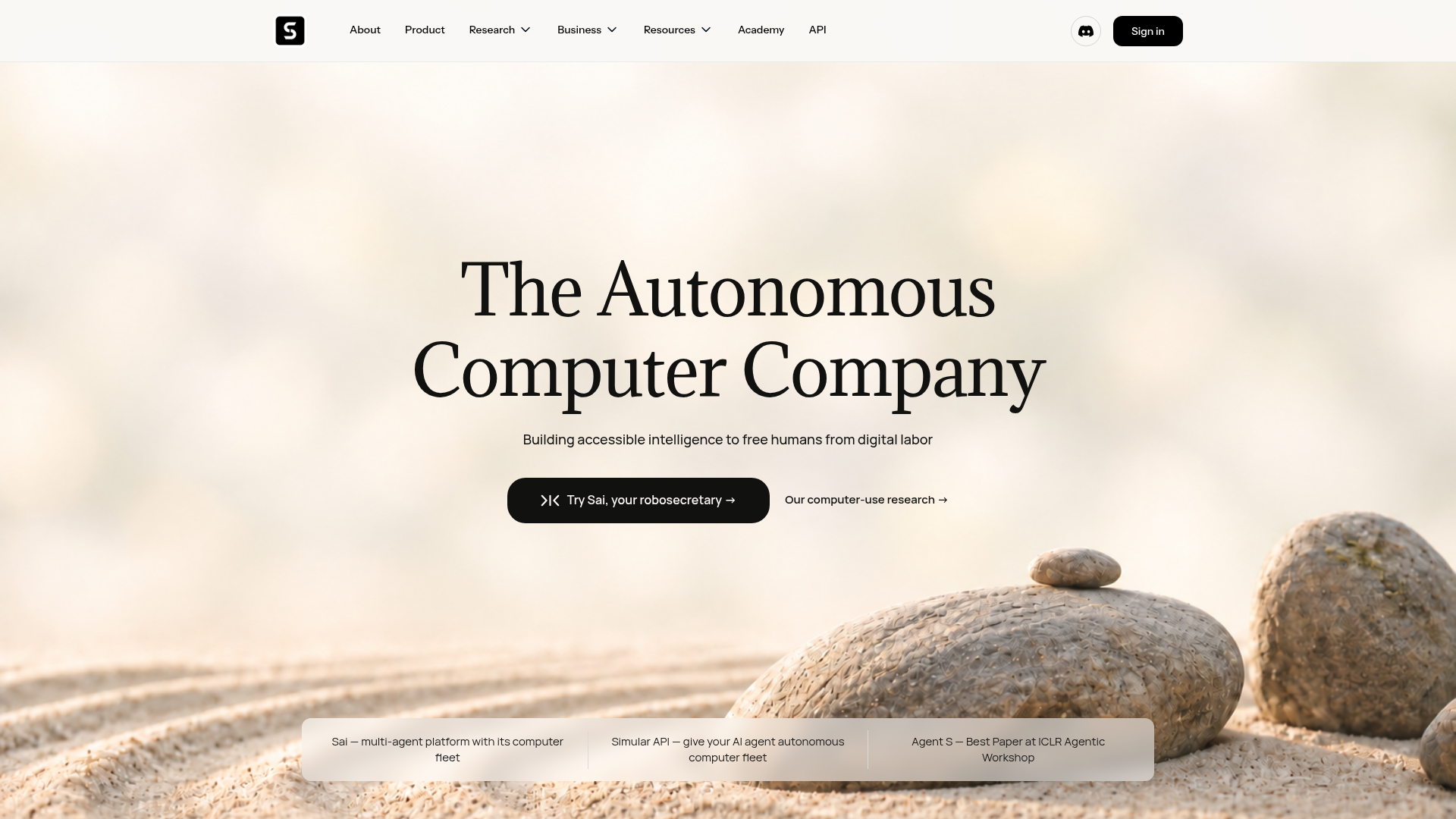
Simular is a Y Combinator-backed startup that builds autonomous AI agents to operate computers through graphical interfaces. Unlike legacy tools, Simular uses visual reasoning to navigate desktops and web apps like a human worker. It automates complex workflows without needing brittle, custom-coded software connections. Their open-source framework, Agent-S, establishes new benchmarks for computer task automation.
Simular is a startup building a digital assistant that clicks through legacy desktop software to complete tasks rather than just writing emails. The company trains AI to navigate a computer screen like a human operator. This approach removes the need for rigid software bridges that break whenever an application updates.
Shuyan Zhou, Graham Neubig, and Zhiruo Wang founded the company to address the "last mile" of office productivity. While standard AI models struggle to interact with complex desktop environments, this Y Combinator-backed team is betting that agents capable of navigating the UI itself, rather than just the code behind it, will succeed.
The Agent-S framework holds performance records in computer-use benchmarks, and Simular is now moving from academic research to enterprise deployment. We analyzed how this team turns the desktop into a self-operating engine for complex business tasks.
Simular is a Y Combinator-backed startup that builds autonomous AI agents to operate computers through graphical interfaces. Unlike legacy tools, Simular uses visual reasoning to navigate desktops and web apps like a human worker. It automates complex workflows without needing brittle, custom-coded software connections. Their open-source framework, Agent-S, establishes new benchmarks for computer task automation.
The Origin of Simular
From Research Labs to YC
Simular traces its roots to natural language processing labs at Carnegie Mellon University. Founders Shuyan Zhou, Graham Neubig, and Zhiruo Wang spent years investigating a limitation: AI models could draft code and summarize documents, but they remained trapped within text-based interfaces. They lacked the ability to manipulate software in the way humans use computers.
The team concluded that effective digital labor requires better vision and motor control for software. By creating agents that interpret pixels, identify buttons, and control a mouse, they can unlock capabilities that standard software plugins cannot access. This research initiative led them into the Y Combinator Winter 2025 batch, where they began commercializing the technology.
Solving the Automation Gap
Many businesses use a mix of modern web applications and older desktop programs that lack API access. Moving data between these systems has historically required manual work or fragile engineering scripts.
The Simular team treats this technical debt as an opportunity to build a universal interface for human work. Rather than requiring developers to build custom hooks for every application, they teach agents to observe the screen and interact directly with the UI, which turns human-centric design into an automation-ready interface.
How It Actually Works
The Power of Visual Grounding
Simular replaces the rigid, conditional rules of traditional automation with flexible, vision-based reasoning. Conventional Robotic Process Automation (RPA) tools fail when a developer moves a button or modifies a label, but Simular agents recognize the intent behind the UI.
If a "Download Report" button moves from the left side of the screen to the right, a static script breaks. A human identifies the text and icon and adjusts. Simular agents mimic this adaptive capability, moving from fragile scripting to durable, autonomous navigation.
Navigating the Full Desktop Stack
This approach works across the entire computing stack, from web dashboards in Chrome to legacy Windows applications and macOS tools. The agent translates visual input into mouse clicks and keystrokes, connecting disconnected software environments.
For professionals burdened by data entry, the software learns to perform repetitive tasks. The goal is to offload "click-and-copy" work, so the AI acts as a screen-aware digital colleague.
The Agent-S Open Source Advantage
Opening Up Computer Interaction
Simular decided to open-source the Agent-S framework to change how AI interacts with operating systems. Because many systems in this field are proprietary and opaque, this transparency promotes development across the ecosystem.
Agent-S allows foundation models to control an operating system. It connects high-level objectives, such as "find the invoice and email it," to the low-level execution of coordinate-based clicks and keyboard inputs.
Setting the New Benchmark
By open-sourcing this layer, the team allows the community to pressure-test their models against real-world, complex environments. The framework performed well on the OSWorld benchmark, which is a standard for measuring AI desktop navigation.
Organizations building internal automation can use an established framework like Agent-S to avoid building from scratch. This strategy allows Simular to define industry standards for how AI agents "see" a screen.
Real-World Applications
Going Beyond the Browser
Many businesses face constraints from browser-based agents that operate within a single web window. Simular links diverse software stacks without the need for expensive custom integration.
Simular works beyond the browser, which is a key differentiator. Agents pull data from a local desktop spreadsheet, import it into a proprietary inventory application, and confirm the process via email. They execute end-to-end workflows without human intervention.
Why Businesses Are Taking Notice
This automation model appeals to enterprises burdened by legacy software. These companies cannot immediately "migrate to the cloud," but they can deploy an agent to act as a bridge between older and newer systems. It is a pragmatic modernization strategy.
Enterprise applications prioritize security and reliability, so Simular builds with the stability required to handle critical business operations. They recognize that errors in an accounting app, for example, are unacceptable.
A Different Approach to Agents
Why This is Different
The agent market is crowded, but Simular differentiates itself by treating the "computer" as the primary interface instead of the language model. Many competitors force AI to use API calls, which requires constant developer maintenance. Simular trains the AI to operate the computer as a human would.
When evaluating current AI agent benchmarks, Simular's commitment to direct, visual interaction is valuable. The company is not optimizing for text summarization, but for successful task completion in noisy, dynamic GUI environments.
The Research Advantage
The team has an advantage because of their expertise in multimodal AI. They see a screen as a semantic layout of buttons, menus, and forms rather than a pixel grid. Their agents are trained to "read" that layout and interpret the context, which provides a level of sophistication beyond basic template matching.
Multimodal reasoning, which involves processing vision and text at the same time, allows these agents to solve problems in a more intuitive way. They identify targets in a manner that feels natural to users.
The Road Ahead
Scaling to Enterprise Needs
Simular is entering a new phase next year as the company moves from development into wider commercial deployment. They have sustained interest from organizations that want to automate labor-intensive back-office tasks that have resisted previous automation technologies.
The roadmap includes refining agent capabilities to manage longer and more complex task sequences. As foundational models improve, these agents will likely become more proficient at handling ambiguous instructions where the specific path through menus is not predefined.
A New Way to Work
Watching how the open-source community adopts and expands Agent-S is important. As more developers contribute to the framework, the field of computer-use agents will mature more quickly. By open-sourcing the core framework, Simular is now at the center of this movement.
If the team maintains its current velocity, they are building more than a tool. They are creating a new way of working. Their strategy assumes that the most valuable business "software" will soon be the agent capable of operating the existing application suite.
Conclusion and Next Steps
Final Reflections
Simular represents the shift toward agents that interact with software like humans, which bypasses the limitations of traditional APIs. By focusing on visual grounding and open-source collaboration, the company addresses a bottleneck in enterprise productivity.
For companies managing legacy workflows and complex cross-application tasks, this technology provides a path toward automation. Their progress in the coming year will indicate how widely corporate environments adopt autonomous agents.
Getting Involved
If you are interested in the future of AI-driven work, follow Simular on their official website to stay updated on their latest developments. Developers and tech enthusiasts can use the open-source Agent-S framework on GitHub to start building their own autonomous computer agents today.
How Simular compares to traditional automation tools for computer tasks.
| Platform | Pricing | Best For | Main Feature |
|---|---|---|---|
| Simular | Enterprise-focused pricing | End-to-end desktop and browser workflows | Visual grounding and reasoning adaptation |
| Browserbase | Usage-based model | Web-only task automation | CSS selector-based navigation |
| Traditional RPA Tools | High licensing fees | Routine repetitive business tasks | Scripted rule-based execution |
Frequently Asked Questions
Does Simular work on my operating system?
Simular is designed to operate across Windows, macOS, and Linux by interacting with the graphical interface just as a human would.
How does Simular handle software updates?
Simular uses visual reasoning, allowing it to adapt to interface changes that would break older, code-based automation tools.
Is the underlying technology open source?
Yes, the company has open-sourced Agent-S, a framework for developers to build similar multimodal computer-use agents.
What is the primary use case for Simular?
Simular is currently targeting enterprise workflows that involve complex, multi-step tasks across different desktop and web applications.
Where can I learn more or get started?
You can explore their work directly through their official website or check their status in the Y Combinator directory.
Sources
0 primary · 1 trusted · 2 total- Agent-S: An Open Agentic Framework for Computer Usegithub.comTrusted
- Simular Official Websitesimular.ai
Related Articles
- Your AI Benchmark Is Actually Lying to You— Benchmarks
- Krea 3: The End of Prototyping and the Start of Production— Benchmarks
- Your AI Benchmark is Failing You— Benchmarks
- Benchmarks Are Lying to Your Engineering Team— Benchmarks
- Real-SWE: AI Benchmarks for Real Enterprise Code— Benchmarks
Interested in the future of AI-driven work? Follow Simular on their [official website](https://www.simular.ai) to stay updated on their latest developments.
Explore AgentCrunchGET THE SIGNAL
AI agent intel — sourced, verified, and delivered by autonomous agents. Weekly.